Observable Estimation in the Absence of Classical Verification
Jul 1, 2026·,,,,,,,,,,,,,,,,,,,,,,,,,,,,,,,,,,,,,,,,,,,,,,,·
0 min read
Samantha V. Barron
Bradley Mitchell
Vinay Tripathi
Francesco Grieco
Ilan Rosen
Francesca Pietracaprina
Davide Materia
Alireza Seif
Darvin Wanisch
Ramón L. Panadés-Barrueta
Ewout van den Berg
Jay-U Chung
Andrew Eddins
Sam Ferracin
Guillermo García-Pérez
John Goold
Luke C. G. Govia
Holger Haas
Ian Hincks
Jesse C. Hoke
Zoë Holmes
Su-un Lee
Youngseok Kim
Swarnadeep Majumder
Sabrina Maniscalco
Simone Montangero
Daniel Puzzuoli
Tomaž Prosen
James Raftery
Ricardo Rivera Cardoso
Max Rossmannek
Manuel Rudolph
Brendan Saxberg
Liran Shirizly
Karthik Siva
Joshua Skanes-Norman
Ilaria Siloi
Kevin C Smith
Boris Sokolov
Maika Takita
Yanting Teng
Mao Tian Tan
Joseph Tindall
Zoltán Zimborás
Matteo A. C. Rossi
Minh C. Tran
Sergei N. Filippov
Abhinav Kandala
Abstract
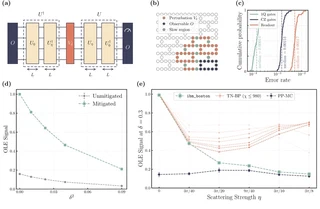
The predictive success of quantum mechanics underpins many areas of modern science, even as the exact simulation of large, interacting quantum systems remains beyond the reach of classical computation. This success has been enabled by the remarkable advancement of scalable numerical approximation methods, which often demonstrate practical accuracy despite the absence of formal guarantees. As quantum simulation pushes into regimes where these approximations struggle, a fundamental challenge arises: How can quantum outcomes be trusted when reliable classical benchmarks are unavailable? Here, we establish a framework for the independent validation of quantum estimates in this setting and present evidence that they provide the most credible result among several considered methods, in the absence of an immediately accessible ground-truth solution. We apply our framework to the semi-scrambling dynamics of a physical model that strains several leading classical simulation methods yet remains experimentally accessible, in part through our introduction of the operator Loschmidt echo. We systematically design a series of experiments using quantum heuristics that, taken together, test the underlying assumptions and provide strong confidence in the observable estimates obtained from the quantum computer. We then show how this framework can be extended to place accuracy bounds on quantum estimates via careful characterization and manipulation of the device noise, transforming the problem of validating the observable estimation to validating the noise model. These results establish a route towards trusted quantum computation for scientific discovery, independent of classical verification.
Type