Mitigating the measurement overhead of ADAPT-VQE with optimized informationally complete generalized measurements
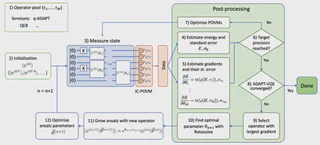
Adaptive derivative-assembled problem-tailored ansatz variational quantum eigensolver (ADAPT-VQE) stands out as a robust algorithm for constructing compact ansätze for molecular simulation. It enables to significantly reduce the circuit depth with respect to other methods, such as unitary coupled cluster singles and doubles, while achieving higher accuracy and not suffering from so-called barren plateaus that hinder the variational optimization of many hardware-efficient ansätze. In its standard implementation, however, it introduces a considerable measurement overhead in the form of gradient evaluations through estimations of many commutator operators. In this work, we mitigate this measurement overhead by exploiting a recently introduced method for energy evaluation relying on adaptive informationally complete generalized measurements (AIMs). Besides offering an efficient way to measure the energy itself, informationally complete (IC) measurement data can be reused to estimate all the commutators of the operators in the operator pool of ADAPT-VQE, using only classically efficient postprocessing. The framework is generic for any IC positive operator-valued measures (POVMs) implementation, and in this work, we demonstrate it’s effectiveness with dilation POVMs. We present the AIM-ADAPT-VQE scheme in detail, and investigate its performance with H4, N2, and 1,3,5,7-octatetraene Hamiltonians and several operator pools. Our numerical simulations indicate that the measurement data obtained to evaluate the energy can be reused to implement ADAPT-VQE with no additional measurement overhead for the systems considered here. In addition, we show that, if the energy is measured within chemical precision, the cnot count in the resulting circuits is close to the ideal one. With scarce measurement data, AIM-ADAPT-VQE still converges to the ground state with high probability, albeit with an increased circuit depth in some cases.