Myths around quantum computation before full fault tolerance: What no-go theorems rule out and what they don't
Jan 1, 2025·,,,,,,,,,,,,,,,,,,,,,·
0 min read
Zoltán Zimborás
Bálint Koczor
Zoë Holmes
Elsi-Mari Borrelli
András Gilyén
Hsin-Yuan Huang
Zhenyu Cai
Antonio Acín
Leandro Aolita
Leonardo Banchi
Fernando G. S. L. Brandão
Daniel Cavalcanti
Toby Cubitt
Sergey N. Filippov
Guillermo García-Pérez
John Goold
Orsolya Kálmán
Elica Kyoseva
Matteo A. C. Rossi
Boris Sokolov
Ivano Tavernelli
Sabrina Maniscalco
Abstract
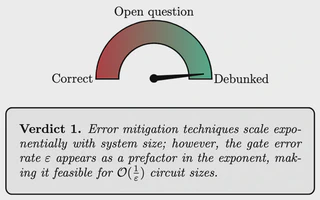
In this perspective article, we revisit and critically evaluate prevailing viewpoints on the capabilities and limitations of near-term quantum computing and its potential transition toward fully fault-tolerant quantum computing. We examine theoretical no-go results and their implications, addressing misconceptions about the practicality of quantum error mitigation techniques and variational quantum algorithms. By emphasizing the nuances of error scaling, circuit depth, and algorithmic feasibility, we highlight viable near-term applications and synergies between error mitigation and early fault-tolerant architectures. Our discussion explores strategies for addressing current challenges, such as barren plateaus in variational circuits and the integration of quantum error mitigation and quantum error correction techniques. We aim to underscore the importance of continued innovation in hardware and algorithmic design to bridge the gap between theoretical potential and practical utility, paving the way for meaningful quantum advantage in the era of late noisy intermediate scale and early fault-tolerant quantum devices.
Type